Independent sourcing partner

Gps glonass internal antenna

LinkScope Sourcing 30 helps a US business buyer write one brief and ask factories for quotes on the same internal GNSS patch. The desk does not own a factory, does not hold stock, and does not assign a verified grade to a maker.

  1. Frequency rangeGPS L1 at 1575.42 MHz and the GLONASS L1 band near 1602 MHz
  2. Impedance and pattern50 ohm, RHCP, gain in dBic, and the radiation pattern the drawing shows
  3. EvidenceDatasheet revision and VSWR method tied to the named model
Request Factory Quotes Review inquiry names
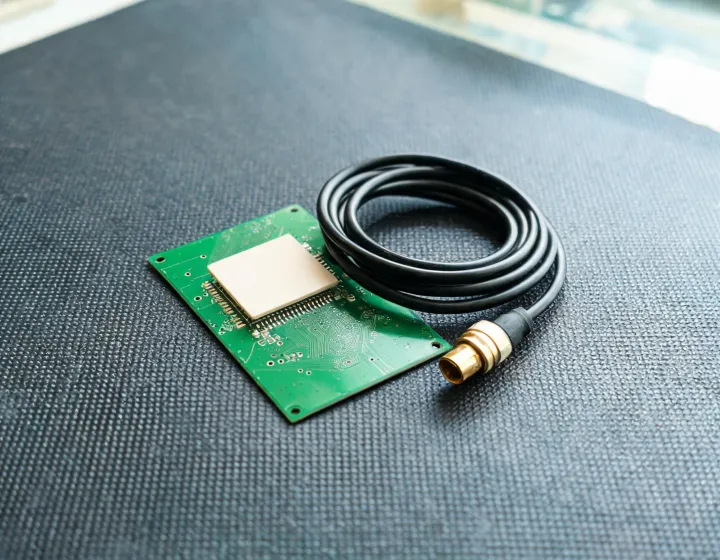
Ceramic GNSS patch on a receiver board at a bench

Lifecycle checks before a patch quote is comparable

A family label such as internal antenna is a starting filter. It does not prove that two ceramics see the same sky. Each row is a question the proposed supplier should answer for the exact model. Public carriers are context: GPS L1 is 1575.42 MHz, and GLONASS L1 occupies roughly 1598.0625 to 1605.375 MHz. The quoted frequency range has to cover the carriers you actually use, including any BeiDou or Galileo line you add later.

StageWhat to lockWhat stays open until a document arrives
BriefHost board keep-out, cable length, connector (often SMA or IPEX), and quantityGain in dBic and axial ratio, until the datasheet names the test
Quote50 ohm impedance, polarization called RHCP, and mounting (adhesive, screw, or solder)Unit price, until currency, Incoterm, and destination match
SampleVSWR limit you will accept, such as 1.5:1 or 2.0:1 across the stated frequency rangeWhether that limit was measured on the host ground plane or on a fixture
IncomingReturn loss or VSWR spot check, plus connector mating cycle if the pigtail is field-matedCalibration traceability of the meter used at the factory

Sourcing scenario: a tracker OEM pastes a photo of a square ceramic and asks for any gps glonass internal antenna. Background is a 40 by 40 mm keep-out on a vehicle telematics board. Process is to mark 1575.42 MHz and the GLONASS L1 span as mandatory, and to reject a GPS-only patch that stops at 1575 MHz. Result is a comparison sheet that does not average a dual-constellation quote with a single-constellation quote.

Measured lines inside this antenna family

These rows follow the measured terms assigned to this site. Search volume is not copied onto the page as a traffic forecast. Each row is a procurement path, not a catalog of owned parts. Read the longer checklist in the procurement brief.

Active distributed antenna system components

Use this path when the bill names a head-end, a remote, or a donor antenna rather than a ceramic patch. Power method, including whether a remote expects Power over Ethernet or a local DC feed, belongs on the line.

Open the inquiry list

Das distributed antenna

Use this path when the purchase is a building coverage set. Write the commercial bands, often 700, 850, 1900, and 2100 MHz, and any public-safety 700 or 800 MHz slice, before you compare insertion loss of splitters.

Build the quote checklist

Enterprise distributed antenna system

Use this path when the site is a campus or a multi-floor office. MIMO order, such as 2x2 or 4x4, and the fiber hop between head-end and remote change both the bill and the optical budget question.

Map the project use

In building distributed antenna system

Use this path when the open items are indoor antennas, corridor coax, and a PIM limit. A buyer line often reads -150 dBc at 2 x 43 dBm. The quote must name the test, not a brochure adjective.

Hand off the open points

Delivery questions buyers ask before the patch ships

Does a matching footprint mean the patch works on the host?

No. A 25 mm ceramic and a 36 mm ceramic can share an SMA pigtail and still miss the keep-out or the ground plane the gain figure assumed. Ask each factory to mark deviations against your board outline.

Where do gain and VSWR come from?

They come from the datasheet of the exact part, usually with a stated ground-plane size. This site does not publish a universal dBic figure for the family. A buyer may request VSWR under 2.0:1 from 1575 to 1606 MHz and then check whether the plot actually spans that frequency range.

What evidence is reasonable to request?

A current datasheet, a mechanical drawing, the polarization callout, and the method behind VSWR or return loss. 47 CFR Part 2 Subpart J is a question source for whether the finished radio needs FCC equipment authorization. It is not an approval stamp this desk can issue for an antenna.

How should a target budget be written?

Give an amount or a range, a currency, and whether the figure is per unit or for the whole order. Freight, duty, cable, and connector upcharges stay outside that figure until a quote lists them. High-end, mid-range, budget, or undecided is your preference, not a factory score.

How should timing and packing be stated?

Write the requested window and the destination city or port. A sample of 10 pieces is not the production quantity. Ask whether the lot ships as tape, tray, or bag, and whether the pigtail connector is protected. Incoming inspection can then check connector mating cycle wear on the sample, not on a photograph.

Compare quotes on one GNSS configuration

Normalize manufacturer, model, frequency range, impedance, polarization, connector, quantity, currency, Incoterm, and destination before you read unit price. A lower-looking unit price with a GPS-only span or a different cable loss is a different purchase.

Measurement accuracy of a factory VSWR plot depends on the fixture. Ask for calibration traceability when the limit is tight, such as 1.5:1. Environmental rating, if the patch sits near a window, is a separate line from indoor board use.

  • Quantity and US destination
  • Requested timing, not a promised ship date
  • Sample versus production lot, called out separately
  • Exclusions: cable, connector, ground plane, freight
Prepare a Telecom RFQ