Interfaces a das distributed antenna quote has to repeat
Passive and active blocks can share a drawing title and still be different purchases. Treat each card as a field the supplier copies back, not as a performance claim from this site. 47 CFR Part 2 Subpart J is the place to ask whether a finished radio needs FCC equipment authorization. The citation does not approve a jumper or a splitter.
Frequency range
List each band in MHz. A common commercial set is 700, 850, 1900, and 2100. Public safety near 700 or 800 MHz is a separate line if the building requires it. A quote that says broadband without numbers cannot be compared with a quote that lists four windows.
Impedance and connectors
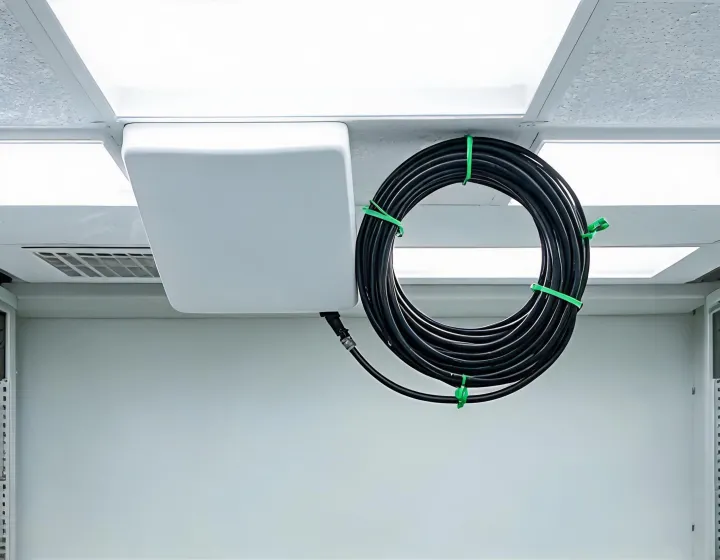
State 50 ohm unless the drawing says otherwise. Name 4.3-10, N-type, or the DIN variant on the donor jumper. Connector mating cycle matters when jumpers are disconnected during test. A photo of a silver connector is not a family match.
Gain, attenuation, insertion loss
Donor antennas carry gain in dBi. Splitters and couplers carry insertion loss and coupling in dB. Return loss, or a VSWR limit such as 1.5:1, should name the band edge. Do not add a dBi figure to a dB loss and call the sum coverage.
Power and environment
Power rating of a combiner is not the same number as the remote power draw. Ask whether a remote expects Power over Ethernet or a local supply. Ingress protection applies to an outdoor donor. An indoor ceiling puck does not inherit that rating.
MIMO, when the service is more than a single path, needs an order such as 2x2. Channel width of the carrier, for example 10 MHz or 20 MHz, is a radio setting the antenna does not choose, but the passive hardware still has to pass that channel. Radiation pattern of a corridor antenna is directional. A ceiling antenna is closer to omnidirectional in azimuth. Write which pattern the floor needs.
Sourcing scenario: a facilities buyer requests a das distributed antenna kit and receives a price that omits the donor. Background is a three-story clinic with a rooftop donor and ceiling antennas on each floor. Process is to split the bill into donor, coax, splitters, and indoor antennas, and to mark the missing donor as out of scope. Result is a second request that cannot be averaged with the incomplete kit price.
Exclusions to force into writing: design files, iBwave or equivalent prediction, permits, fiber if the head-end is remote, commissioning, spares, freight, duty, and lift equipment. A sample antenna is not the floor quantity. If a factory names a minimum, record the number and the unit. Polarization for most in-building service antennas is vertical or slant, which is a different note from the RHCP call used on a GNSS patch.
Two commercial choices stay open. An OEM-coded head-end may follow the carrier or the host-vendor support text more closely, while a compatible remote may be quoted when the buyer accepts a labeled deviation on management and alarms. A new donor has a clearer PIM record than a refurbished panel, which can still match the band and fail a -150 dBc check at 2 x 43 dBm. Quote both paths when the brief asks, and do not merge the prices. New versus refurbished is a condition column, not a slogan.